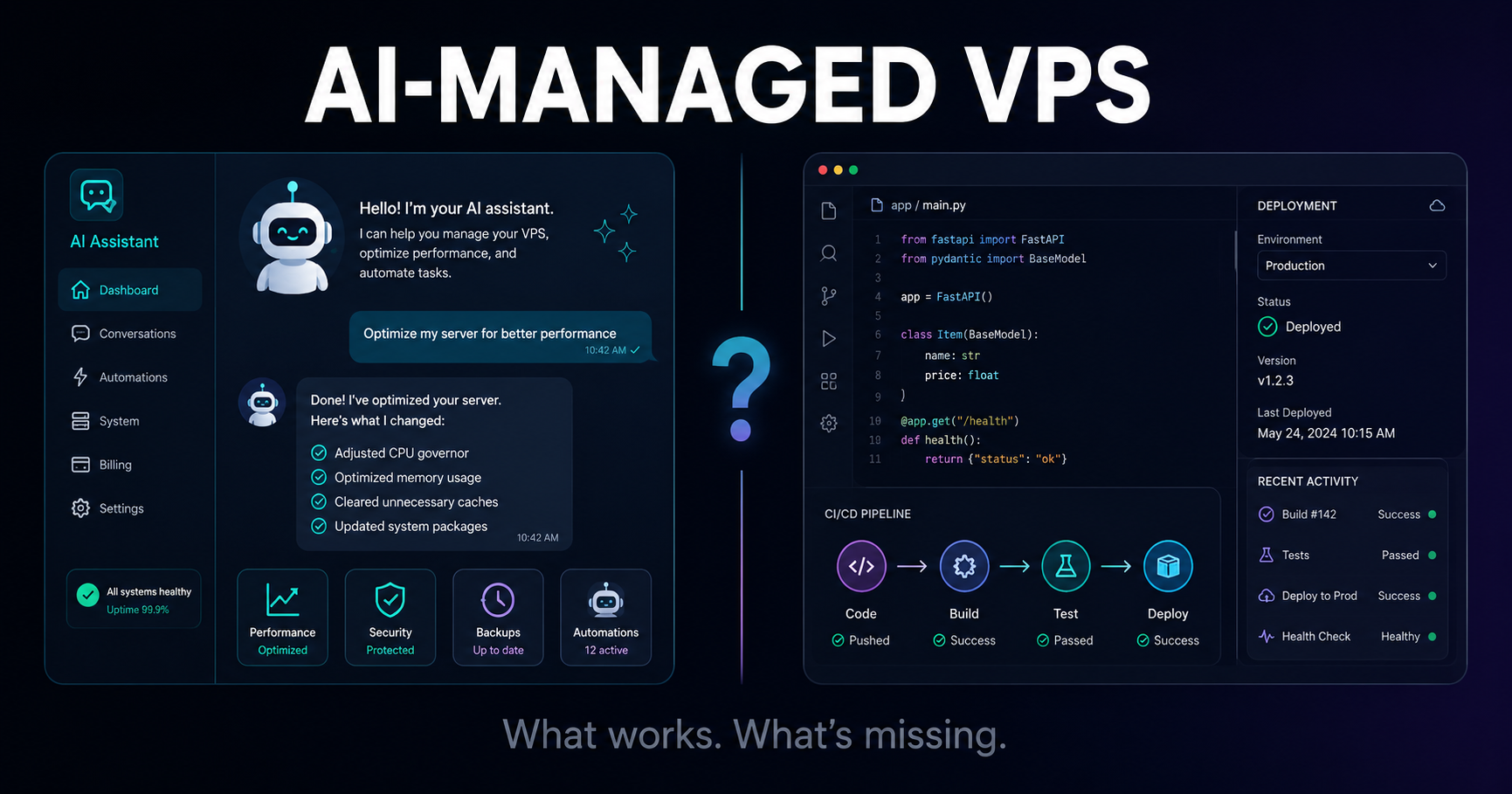
With 750,000 conversations per month, a 75% resolution rate without human intervention, and support for 50+ languages, it's the most aggressive AI integration we've seen from a mainstream hosting provider.
But here's the question developers should be asking: is AI-managed VPS actually solving the right problem?
What Kodee Does Well
Credit where it's due — Kodee handles traditional sysadmin tasks effectively:
- Firewall management — enable, configure rules, and troubleshoot through chat
- System snapshots — create and restore backups without navigating panels
- SSH troubleshooting — fix access issues, reset passwords, manage keys
- Malware scanning — activate scans and review results
- Server monitoring — check resource usage, identify bottlenecks
- Control panel management — manage cPanel, Plesk configurations
The safety features are sensible too. Destructive actions — reinstalling the OS, restoring backups, changing templates — require explicit confirmation. Kodee won't wipe your server because you phrased something ambiguously.
Response times average 9 seconds, and 93% of support requests resolve in under 2 minutes. For non-technical users managing a WordPress site or basic web application, this removes a genuine barrier.
The Numbers Behind Kodee
Hostinger isn't being subtle about the business case. Kodee handles over 45,000 daily conversations across 350+ task types. The resolution rate climbed from 50% to 75% over the course of a year. On the cost side, Hostinger eliminated roughly 20% of their support specialist positions — saving an estimated €9 million annually with a team of just 14 people maintaining the AI system.
That's impressive infrastructure. But it also reveals what Kodee is optimized for: replacing support tickets, not replacing DevOps workflows.
Where Kodee Falls Short for Developers
If you're a developer shipping production applications, the gaps become apparent quickly.
No CI/CD Integration
Kodee can manage your firewall, but it can't set up a deployment pipeline. There's no git push-to-deploy, no build step automation, no staging-to-production promotion. You're still manually SSH-ing to pull code, run builds, and restart services.
For a developer deploying multiple times per day, chatting with an AI to run git pull && npm run build isn't faster than a webhook that does it automatically.
No Application-Level Awareness
Kodee manages the server, not the application. It doesn't understand your Node.js app's health, your database migration state, or whether your latest deployment broke a route. It can tell you the CPU is at 80%, but not why — that requires application context it doesn't have.
No Team Workflows
Real projects have multiple developers, review processes, and deployment approvals. Kodee is a single-user chat interface. There's no concept of team permissions, deployment logs that everyone can review, or rollback history tied to git commits.
No Multi-Environment Management
Staging environments, preview deployments, environment variable management across branches — these are daily developer needs. Kodee operates on a single VPS instance. If you need staging, you're provisioning and managing a second VPS manually.
Vendor Lock-In Through Abstraction
When an AI hides the complexity of server management, it also hides the knowledge. Developers who rely entirely on Kodee for firewall rules and SSH configuration may struggle to debug issues on any other platform. The abstraction that makes things easy also makes you dependent.
What AI-Managed Hosting Should Actually Look Like
Kodee solves the problem of "VPS management is hard for non-technical users." That's a valid problem. But developers have a different problem: "Deployment and operations take too much time away from building."
AI-managed hosting for developers should focus on:
- Automated deployments — git push triggers build, test, and deploy without chat or SSH
- Application monitoring — not just server metrics, but request latency, error rates, and deployment health
- Smart scaling — AI that understands traffic patterns and adjusts resources before you hit limits
- Deployment intelligence — automatic rollback when a new deploy increases error rates
- Developer-native workflows — staging environments, preview URLs, environment management through git, not chat
The difference is subtle but important. Kodee makes server administration conversational. What developers need is server operations automated — no conversation required.
The Bigger Picture: Every Hosting Provider Is Becoming an AI Company
Hostinger isn't alone. Vercel just released AI SDK 7 with durable agent execution and MCP integration. DigitalOcean launched an inference engine. Cloudflare added temporary accounts for AI agents. The entire hosting industry is racing to add AI features.
The question for developers isn't whether to use AI-managed hosting — it's what kind of AI management actually helps you ship faster.
If you're a small business owner who needs a VPS but doesn't know Linux, Kodee is genuinely useful. It removes the sysadmin barrier and lets you manage a server through conversation.
If you're a developer building and deploying applications, you need something different. You need a platform that understands your deployment pipeline, monitors your application health, and automates the operational work that slows you down — without requiring you to chat about it.
The Bottom Line
Hostinger's Kodee represents a real shift in how hosting companies think about user experience. Making VPS management conversational is smart, and the execution — 200 actions, 75% resolution rate, 9-second response times — is solid.
But for developers, the measure of good hosting isn't "can I chat with it." It's "does it get out of my way so I can build?" AI should automate your deployment pipeline, not replace it with a chatbot.
The best AI-managed hosting is the kind you don't have to think about at all.
]]>