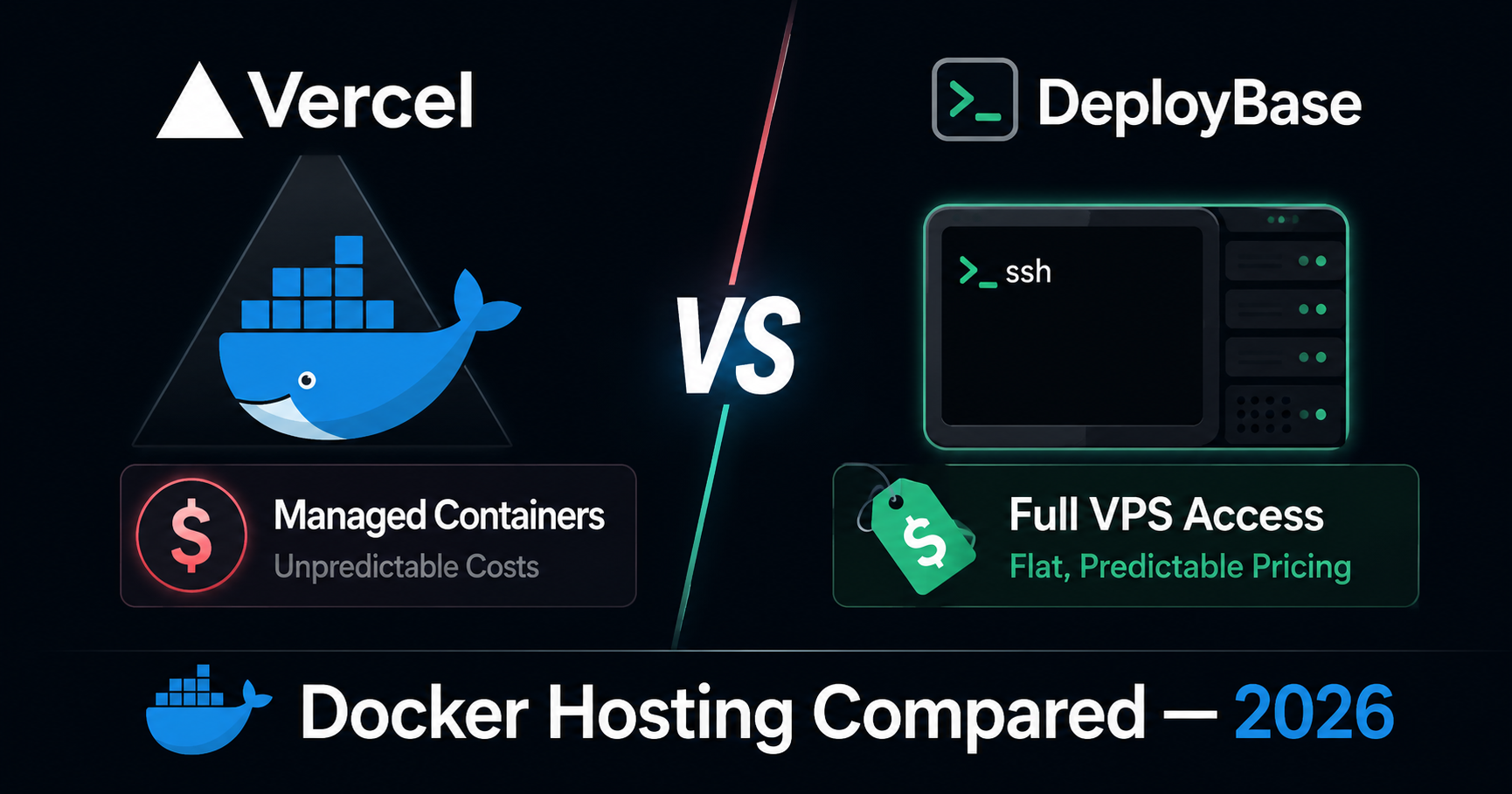
Dockerfile.vercel to your project and deploy any containerized application — Go, Rails, Laravel, Spring Boot, Express, anything — on Vercel's infrastructure with autoscaling, preview deployments, and integrated observability.
This is a significant move. Vercel has traditionally been a frontend-first platform built around Next.js. With Docker support, they're stepping directly into full-stack hosting territory.
But Docker support alone doesn't make Vercel a VPS replacement. The details — pricing, control, constraints, and what happens when things go wrong — matter more than the feature announcement.
Here's an honest comparison between Vercel's new container hosting and what you get with DeployBase.
How Vercel's Docker Support Works
Vercel's approach is opinionated by design. You add a Dockerfile.vercel to your repo, push to git, and Vercel builds, stores, and deploys the image on their Fluid compute infrastructure.
Key constraints:
- Stateless only — each container is a stateless process. It takes a request, returns a response, and keeps nothing in between. Persistent state requires external services from Vercel's marketplace.
- HTTP only — your application must speak HTTP and listen on
$PORT. No raw TCP, no WebSocket servers running independently, no background workers outside the request cycle. - No durable storage — local filesystem writes don't persist between requests. Durable storage is listed as "coming soon."
- Usage-based billing — you pay for active CPU time, not provisioned resources.
The preview deployment workflow is excellent — every git push creates an immutable preview URL. Autoscaling works in both directions. These are genuine strengths.
How DeployBase Handles Docker
DeployBase takes a fundamentally different approach. Your app runs always-on in a container with persistent storage, SSH access from the Pro plan, and flat monthly pricing.
- Stateful or stateless — run databases, caches, queues, and background workers on the same server. Your data persists because it's your disk.
- Any protocol — HTTP, WebSocket, TCP, UDP, gRPC. No protocol restrictions.
- Full filesystem — write to disk, store uploads, generate files. Your server, your storage.
- Fixed pricing — you know exactly what you'll pay every month. No metered billing surprises.
- SSH access — debug production issues in real-time. Tail logs, inspect processes, run commands.
Pricing: Predictable vs Metered
This is where the comparison gets uncomfortable for Vercel.
Vercel's Pro plan starts at $20/user/month with $20 in usage credits. Beyond that:
- Serverless functions: $0.60 per million invocations + $0.128/CPU-hour + $0.0106/GB-hour memory
- Bandwidth: $0.15/GB after 1TB
- Edge requests: metered after 10M
For a container running continuously with moderate traffic, costs can escalate quickly. A backend service handling 100 requests/second with 512MB memory could generate significant monthly bills beyond the base plan — and the exact amount is hard to predict in advance.
DeployBase pricing is flat. You choose a plan, you pay that amount. Whether your server handles 10 requests or 10,000 requests per second, the bill doesn't change. For production workloads with consistent traffic, this eliminates the billing anxiety that comes with usage-based pricing.
Control: Managed vs Full Access
| Feature | Vercel Containers | DeployBase |
|---|---|---|
| SSH Access | No | Yes, from the Pro plan (unprivileged, not root) |
| Custom nginx/Apache config | No | PHP sites: .htaccess (AllowOverride All). Node sites: not applicable |
| Long-running processes | No (stateless only) | Your app process runs continuously; no process manager |
| Database on same server | No (external service required) | Yes — MySQL, PostgreSQL, Redis, MongoDB, as per-account containers on the same host |
| File uploads/storage | No persistent storage | Yes — /app is host-mounted and persists |
| Custom system packages | Via Dockerfile only | No — extra OS packages are installed by us on request |
| WebSocket servers | Limited (HTTP only) | Yes — verified on a live tenant holding persistent connections |
| Cron jobs | Via Vercel Cron (limited) | Scheduled cron per site, on every plan |
| SSL configuration | Automatic only | Automatic (Let's Encrypt via Traefik). No custom certificate upload |
| Git push deploy | Yes | Yes, Pro and above |
| Preview deployments | Yes (built-in) | Staging environments, Business and above |
| Autoscaling | Yes (automatic) | No autoscaling — resize by changing plan |
When Vercel Makes Sense
Vercel's container hosting is a strong choice when:
- Your backend is truly stateless and request-driven
- You want zero-config autoscaling without managing infrastructure
- Preview deployments per PR are essential to your workflow
- Your traffic is bursty — high peaks with long idle periods (usage-based billing works in your favor)
- You're already in the Vercel ecosystem with a Next.js frontend
When DeployBase Makes Sense
DeployBase is the better fit when:
- You need persistent storage, databases, or background workers on the same server
- Your traffic is consistent — fixed pricing beats usage-based billing
- You need SSH access for debugging, maintenance, or custom configuration
- You run WebSocket servers, queues, or non-HTTP services
- You want always-on apps with SSH access (Pro and above) and flat monthly pricing
- Vendor lock-in is a concern — your code runs the same way anywhere with a VPS
- You need to comply with data residency requirements and want to choose your server location
The Vendor Lock-In Question
Vercel's Dockerfile.vercel is a Vercel-specific file. Your regular Dockerfile doesn't deploy directly — you need their format, their build system, and their constraints (stateless, HTTP-only, no persistent storage). Moving away means rearchitecting for persistent state, background processing, and different deployment workflows.
With a VPS, your Docker setup works everywhere. The same docker-compose.yml that runs on DeployBase runs on any other VPS provider, on AWS EC2, on your own hardware. There's nothing proprietary to migrate away from.
The Real Question
Vercel adding Docker support is a smart product move. It addresses a real gap — teams that outgrew serverless but wanted to stay on the platform.
But "we support Docker" and "your app runs always-on at a flat price" are fundamentally different propositions. Vercel gives you managed, constrained containers with usage-based pricing. DeployBase gives you always-on containers with predictable flat costs.
The right choice depends on your architecture, your traffic patterns, and how much control you need. If your application is stateless and bursty, Vercel's model is efficient. If your application needs persistent state, background processing, or predictable billing, a VPS is the straightforward answer.
Don't choose based on feature announcements. Choose based on what your application actually needs to run reliably in production.
]]>