DigitalOcean released Q1 2026 earnings this morning and the numbers tell a clear story: the company's aggressive pivot to AI infrastructure is working. Revenue hit $258 million (+22% year-over-year), beating consensus estimates of $249.7M. The stock jumped 17.2% in response.
But if you're a developer who just wants to deploy a Rails app, a Next.js site, or a simple WordPress blog — the company DigitalOcean is becoming may not be for you anymore.
AI ARR Dominates the Growth Story
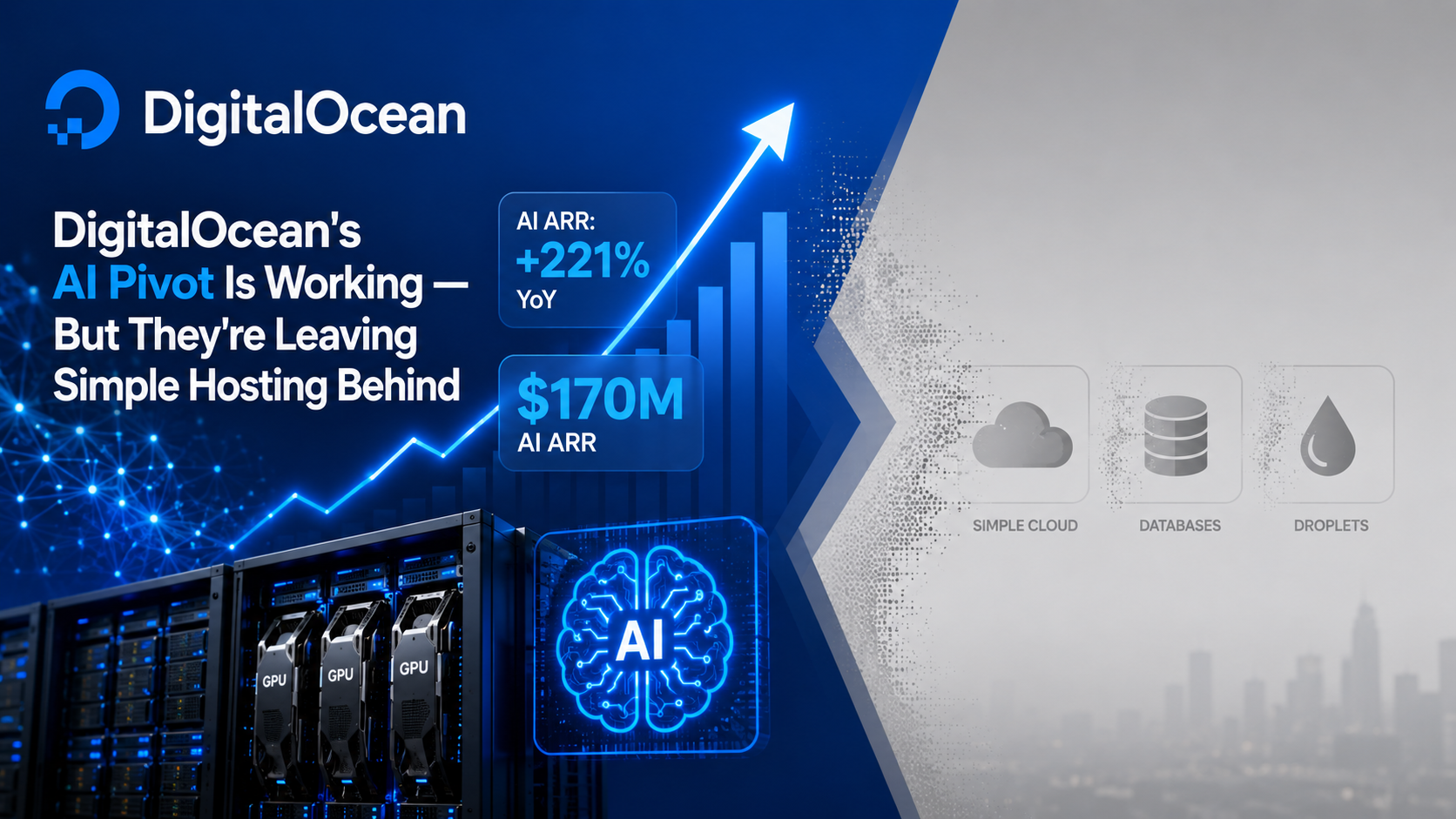
The headline number: DigitalOcean's AI Annual Recurring Revenue (ARR) reached $170 million in Q1 2026, up from $120M in Q4 2025 and $53M a year ago. That's +221% year-over-year growth.
To put that trajectory in perspective:
- Q1 2025: $53M AI ARR
- Q4 2025: $120M AI ARR (+126% in 3 quarters)
- Q1 2026: $170M AI ARR (+42% in a single quarter)
AI workloads now represent a significant portion of DigitalOcean's growth engine. The company added a record $62 million in incremental organic ARR in Q1 — and the majority of that came from enterprise AI customers, not from developers spinning up $6/month droplets.
The $1M+ Customer Cohort Is Where the Action Is
DigitalOcean's customer ARR from accounts spending $1 million or more annually grew 179% year-over-year to $183 million. These aren't freelancers deploying side projects. These are AI startups running inference workloads, training models, and consuming GPU compute at scale.
Examples from the earnings call:
- Character AI: Achieved 100% throughput increase and ~50% lower cost per token by migrating to DigitalOcean's AMD Instinct GPU infrastructure.
- Hippocratic AI: Selected DigitalOcean for HIPAA-compliant clinical AI workloads running on NVIDIA-optimized infrastructure.
- OpenClaw adoption: ~30,000 one-click GPU droplets launched shortly after the product's release.
This isn't the DigitalOcean of "$5 VPS for developers." This is enterprise cloud infrastructure competing with AWS, Google Cloud, and Azure — just focused on AI workloads instead of general compute.
Guidance Raised: 50%+ Growth in 2027
DigitalOcean didn't just beat Q1 — they raised full-year 2026 guidance to 26% growth (from the previous 19-23% range). More importantly, they raised 2027 guidance to 50%+ growth.
Let's be clear: that 50% growth target isn't coming from developers deploying static sites or small databases. It's coming from AI cloud revenue. The company is committing 31 megawatts of new data center capacity in 2026 (6MW in Q2, 25MW in H2) specifically to support GPU workloads and inference demand.
Compare DigitalOcean's 22% revenue growth to the hyperscalers:
- Google Cloud: +63% (heavily AI-driven)
- Azure: +40% (Microsoft's Copilot + OpenAI partnership)
- AWS: +28% (broad cloud services + AI)
DigitalOcean is no longer in a different category than the hyperscalers. They're competing for the same AI workloads — just with a developer-first API and simpler pricing (for now).
What This Means for Simple Hosting Users
If you're running a Laravel app, a WordPress site, or a Node.js API on DigitalOcean today, you might be wondering: what does this mean for me?
Here's the reality of how cloud companies evolve when they pivot upmarket:
1. Pricing Follows the Customer Mix
When your average customer spends $1M+ annually instead of $60/year, product and pricing decisions reflect that. Simple VPS droplets don't get the same product attention, feature velocity, or support investment as enterprise AI contracts.
2. Support Tiers Shift
Enterprise customers paying seven figures get dedicated account managers, custom SLAs, and direct engineering escalation paths. Developers on $6/month plans get community forums and ticket queues. This isn't criticism — it's economics. But it changes the user experience.
3. Product Roadmap Prioritization
DigitalOcean's product announcements increasingly focus on GPU availability, inference optimization, model serving APIs, and HIPAA compliance. When was the last time they shipped a feature specifically for developers running a simple web app?
4. Inevitable Price Increases
As infrastructure costs rise (DRAM prices surged 90% in Q1 2026, another 58-63% expected in Q2) and the company's focus shifts to higher-margin AI workloads, entry-level pricing gets less attention. Budget-conscious developers may see price increases or reduced feature parity at lower tiers.
The Market DigitalOcean Used to Own
Five years ago, DigitalOcean was the obvious choice for developers who wanted VPS hosting without AWS's complexity or Heroku's vendor lock-in. Their value proposition was simple:
- Predictable pricing ($5, $10, $20/month droplets)
- Developer-friendly APIs and CLI
- SSD-backed VPS instances with root access
- No surprise bills, no confusing product SKUs
- Focus on simplicity over enterprise features
That market still exists. Developers still need affordable, simple hosting for side projects, small businesses, and MVPs. But DigitalOcean is no longer building primarily for that customer.
The company's investor pitch is now "AI-native cloud infrastructure" — not "simple cloud for developers."
Where DeployBase Fits
DeployBase started with a different thesis: what if hosting stayed simple?
While DigitalOcean chases $1M+ AI contracts, there are still millions of developers who need:
- Container-based hosting — Deploy WordPress, Laravel, Node.js apps without managing Kubernetes or Docker Compose yourself.
- Transparent pricing — Know what you'll pay before you deploy. No surprise egress fees, no per-request API charges.
- Automatic SSL and backups — Let's Encrypt provisioning, daily backups, one-click restore. These should be standard, not add-ons.
- SSH access without complexity — Full shell access to your container, Git-based deployments, but without having to configure load balancers or VPC networking.
- Isolation without shared hosting risks — Each app in its own Docker container. No cPanel dependency, no shared PHP processes.
We're not competing with DigitalOcean for Character AI's inference workloads. We're serving the market they're leaving behind: developers who want reliable, affordable hosting that doesn't require a DevOps team.
The Numbers Don't Lie
DigitalOcean's Q1 2026 earnings prove their AI strategy is working. Revenue growth is accelerating, margins are strong (36-38% adjusted EBITDA), and Wall Street is rewarding the pivot with a 17% stock pop.
But for every Character AI spending millions on GPU inference, there are thousands of developers who just want to deploy their Next.js app without learning Terraform. For every Hippocratic AI needing HIPAA-compliant model serving, there are bootstrapped startups that need a $20/month Laravel environment that just works.
DigitalOcean made a strategic choice: go upmarket, chase enterprise AI revenue, compete with hyperscalers. It's a valid strategy. The earnings prove it's working.
But it leaves a gap. And that's the gap DeployBase is built to fill: simple, developer-focused hosting for the 99% of projects that don't need GPU clusters or $1M annual contracts.
If you're running a web app on DigitalOcean today and wondering whether the platform is still built for you — that's a fair question. The company's own earnings call suggests their future is AI infrastructure, not $5 droplets.
We're here when you're ready to switch.